Is Your Campus Breakroom Ready for the School Year? 9 Things to Evaluate
Teachers and staff are back on campus, making the breakroom a central part of their daily workplace experience. Evaluate your current refreshment program across nine essential criteria.


Teachers and staff are back on campus.
The question is whether your breakroom is ready for them.
Coffee, snacks and beverages might seem like small details compared with everything else required to run a campus. But they are part of the everyday experience for the people who spend their days there.
And when something is missing, out of stock, overpriced or unavailable, people notice.
So as the school year gets underway, it is worth taking a closer look at how your current refreshment program is actually performing.
Here are nine things we would evaluate.
1. Are the Products People Actually Want Available?
A stocked machine does not necessarily mean a useful machine.
Look at what employees are buying, what consistently sells out and what people are asking for that never seems to appear.
The goal is not simply to have products available.
It is to have the right products available for the people using the campus.
2. Is There Enough Variety?
One product mix rarely works for everyone.
Staff have different preferences around snacks, beverages, coffee and dietary needs.
A good campus program should create enough variety to serve those different preferences without turning the breakroom into an oversized inventory list.
Look at your current mix.
What is selling? What is sitting? What are employees asking for?
Those answers should influence what comes next.
3. Are Healthy Choices Actually Part of the Mix?
"Healthy options available" can be an easy box to check.
The better question is whether healthier choices represent a meaningful part of the overall selection.
AVS looks at the broader product mix and considers whether it reflects the people using the location.
That can include better snack choices, whole food options, hydration and products that support different dietary preferences.
The goal is a refreshment program that gives employees choices rather than simply adding one healthy product to an otherwise unchanged assortment.
4. Is Hydration Easy to Find?
Hydration matters throughout the year, but it becomes particularly relevant as campuses move through warmer months and active fall routines.
AVS uses a benchmark of approximately 25% of beverage selections focused on hydration during this time of year.
That can include water and other appropriate hydration options based on the location and employee preferences.
The important part is understanding whether hydration is actually accessible when employees need it.
Validation note: Confirm the 25% benchmark with Ty before publication as an approved public AVS benchmark.
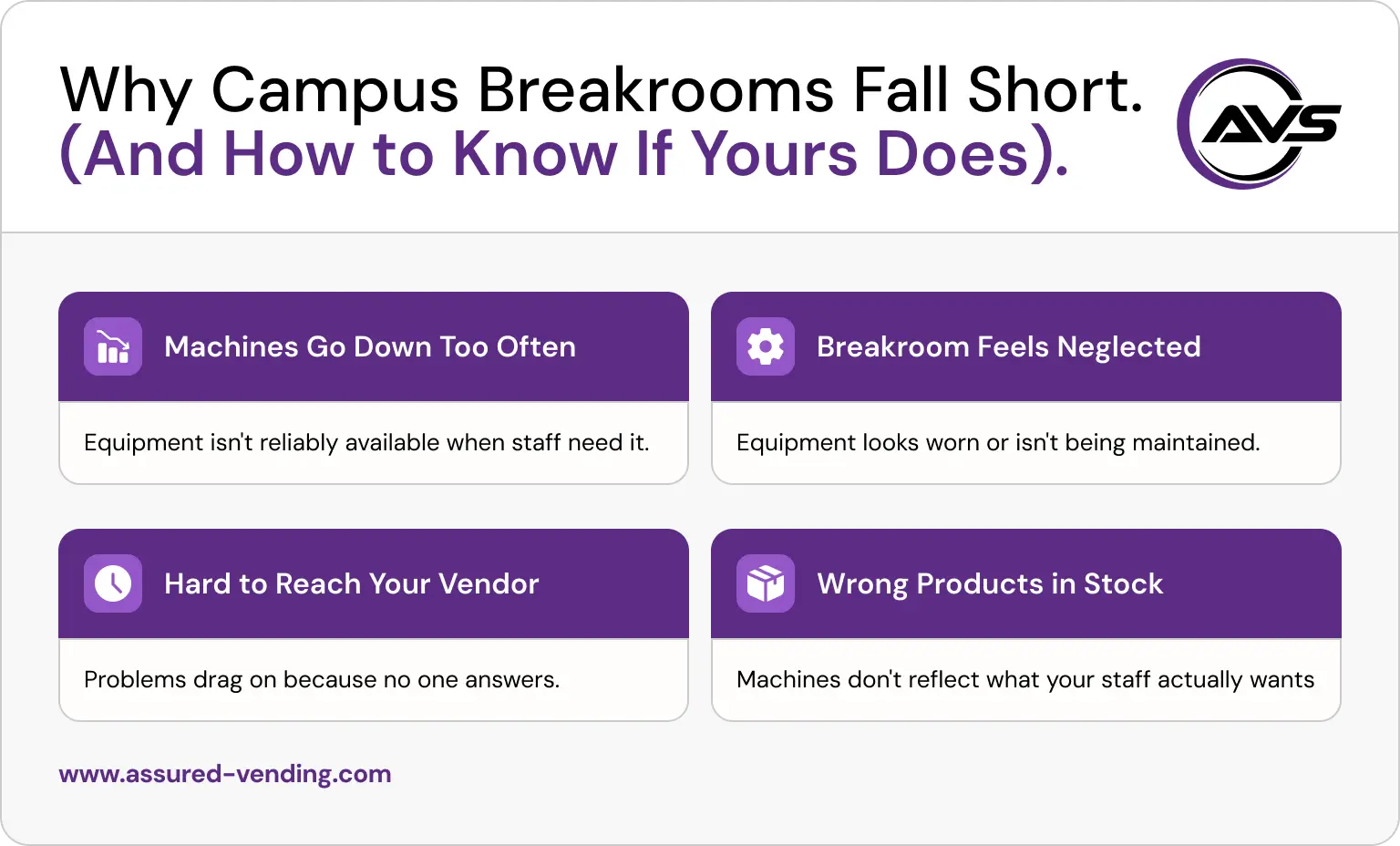
5. How Quickly Are Problems Resolved?
Vending machines are going to have vending machine problems.
The real difference is what happens next.
If a machine goes down, a product is missing or an employee has an issue, how quickly can someone get an answer?
Can they reach their account manager?
Does someone respond?
Does the problem actually get resolved?
For AVS, service responsiveness is part of the refreshment experience, not something that happens separately from it.
6. How Reliable Is Your Equipment?
Uptime matters because an unavailable machine is an unavailable service.
Evaluate:
- How often machines are down
- How long they remain unavailable
- Whether problems are communicated
- How quickly service is dispatched
- Whether recurring equipment issues are being addressed
A machine can look fine during a quick walkthrough and still create a frustrating experience if it regularly fails when employees need it.
7. Are Employee Requests Actually Being Heard?
One of the easiest ways to understand whether a program is working is to listen to the people using it.
What products are employees requesting?
How often are those requests fulfilled?
Does the provider make adjustments based on what people are asking for?
AVS uses employee requests as one part of evaluating the overall program.
Because the best product mix is not determined from a catalog.
It is informed by the people actually using the location.
8. Is Your Breakroom Being Maintained?
Cleanliness is easy to overlook because it is usually only noticed when it is missing.
Machines should receive cosmetic cleaning as part of regular service, while deeper equipment maintenance should happen on an appropriate schedule.
For AVS, that includes attention to the compressors and internal cabinets as part of ongoing equipment care.
A refreshment program should look cared for because the people using it notice when it does not.
Validation note: Confirm the specific cleaning cadence and any energy efficiency language with Ty before publication.
9. Can You Actually Reach Your Vendor?
This may be the simplest test of all.
If something goes wrong today, who do you call?
And more importantly:
Will they answer?
A campus refreshment program is ultimately a service relationship.
The machines, products and technology matter.
But the people behind them matter just as much.
That is one reason AVS approaches its work as a local DFW partnership. The goal is to understand the location, respond to the people using it and continually improve the program based on what is actually happening.
A Simple Way to Evaluate Your Current Program
If you want to pressure test your existing campus refreshment program, start with these four areas:
PRODUCT
Availability
Are the products people want actually there?
Variety
Does the assortment reflect different preferences?
Hydration
Is hydration appropriately represented?
Healthy Choices
Are better options meaningfully available?
SERVICE
Response Time
How quickly are problems addressed?
Employee Requests
Are requests being acted on?
Account Management
Can you reach someone when you need help?
EQUIPMENT
Uptime
How often are machines unavailable?
Cleanliness
Does the equipment look and feel maintained?
Execution
Is the program consistently being serviced?
EXPERIENCE
Ultimately, these questions point toward one bigger question:
Is your current refreshment program making campus life easier for your staff?
If the answer is unclear, that is worth investigating.
Start With a Fresh Look
You do not have to change vendors to understand what could be better.
AVS can provide a Free Breakroom Assessment to evaluate your current setup and identify opportunities across product selection, availability, service, equipment and overall experience.
For organizations that want to go further, the 30 Day Vendor Challenge provides a structured way to benchmark the current program against defined service and performance standards.
The goal is simple:
Understand what is working. Identify what is not. See what could improve.
Schedule Your Free Breakroom Assessment
FAQ
What should a campus breakroom include?
A strong campus breakroom should provide an appropriate mix of coffee, snacks, beverages, hydration and better choice options based on the people using the location.
How often should a campus vending program be evaluated?
There is no universal schedule because needs vary by location. A seasonal review, employee feedback and ongoing service performance can help identify when the program needs adjustment.
What should I evaluate in my current vending program?
Start with product availability, variety, hydration, healthy choices, pricing, equipment uptime, cleanliness, employee requests and service responsiveness.
What is the 30 Day Vendor Challenge?
The 30 Day Vendor Challenge is an AVS benchmarking exercise designed to evaluate an existing vending program against defined performance and service standards before a customer makes a larger vendor decision.
Can AVS evaluate our existing breakroom without us changing vendors?
Yes. The assessment is designed to identify opportunities within an existing program without requiring an immediate vendor change.
Break Room Tips & Workplace Insights, Delivered to Your Inbox.
Get the latest product trends, expert tips, and exclusive AVS offers, straight to your inbox.